Spalling
Reviewed by licensed engineers
Checked against its sources by licensed professional engineers on the previous site, where reviewers weren’t recorded by name.
On this page · 4 sections
Description
Cracking, breaking or chipping of joint/crack edges. Usually occurs within about 0.6 m (2 ft.) of joint/crack edge.
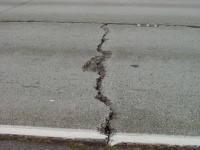


Problem
Loose debris on the pavement, roughness, generally an indicator of advanced joint/crack deterioration
Possible Causes
Possible causes are (AASHTO, 19931):
- Excessive stresses at the joint/crack caused by infiltration of incompressible materials and subsequent expansion (can also cause blowups).
- Disintegration of the PCC from freeze-thaw action or "D" cracking.
- Weak PCC at a joint caused by inadequate consolidation during construction. This can sometimes occur at a construction joint if (1) low quality PCC is used to fill in the last bit of slab volume or (2) dowels are improperly inserted.
- Misalignment or corroded dowel.
- Heavy traffic loading.
Repair
Spalling less than 75 mm (3 inches) from the crack face can generally be repaired with a partial-depth patch. Spalling greater than about 75 mm (3 inches) from the crack face may indicated possible spalling at the joint bottom and should be repaired with a full-depth patch.
Teaching this? Figures and worked examples are free to use with credit. How to cite
Cite this page
APA
Pavement Interactive. (2018, September 19). Spalling. HeadLight. Retrieved [the date you read it], from https://pavementinteractive.org/reference-desk/pavement-management/pavement-distresses/spalling/
ASCE
Pavement Interactive. (2018). “Spalling.” HeadLight, <https://pavementinteractive.org/reference-desk/pavement-management/pavement-distresses/spalling/> ([the date you read it]).
BibTeX
@misc{pavint-spalling,
  author = {{Pavement Interactive}},
  title = {Spalling},
  year = {2018},
  publisher = {HeadLight},
  howpublished = {\url{https://pavementinteractive.org/reference-desk/pavement-management/pavement-distresses/spalling/}},
  note = {Accessed [date]}
}Sources (1)
- AASHTO (1993). AASHTO Guide for Design of Pavement Structures. American Association of State Highway and Transportation Officials. Washington, D.C. ↩