Continuously Reinforced Concrete Pavement
Reviewed by licensed engineers
Checked against its sources by licensed professional engineers on the previous site, where reviewers weren’t recorded by name.
Continuously reinforced concrete pavement (CRCP, see Figure 1) does not require any contraction joints. Transverse cracks are allowed to form but are held tightly together with continuous reinforcing steel. Research has shown that the maximum allowable design crack width is about 0.5 mm (0.02 inches) to protect against spalling and water penetration (CRSI, 19961). Cracks typically form at intervals of 1.1 - 2.4 m (3.5 - 8 ft.). Reinforcing steel usually constitutes about 0.6 - 0.7 percent of the cross-sectional pavement area and is located near mid-depth in the slab. Typically, No. 5 and No. 6 deformed reinforcing bars are used.
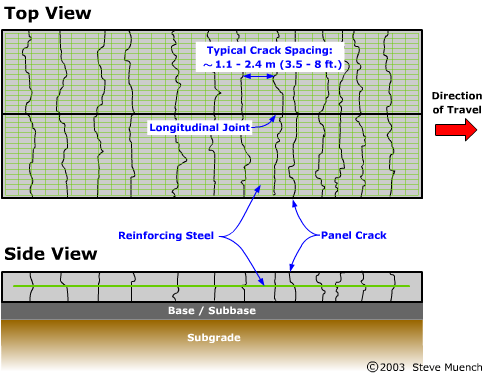
During the 1970's and early 1980's, CRCP design thickness was typically about 80 percent of the thickness of JPCP. However, a substantial number of these thinner pavements developed distress sooner than anticipated and as a consequence, the current trend is to make CRCP the same thickness as JPCP (FHWA, June 19902). The reinforcing steel is assumed to only handle nonload-related stresses and any structural contribution to resisting loads is ignored. This last point is important. While many structural concrete applications use reinforcing steel to account for tensile stresses (as concrete is poor in resisting tensile stress), concrete pavement does not. The reinforcing steel in CRCP is located at the neutral axis or sometimes shallower (in the compression zone), where there is no tensile stress (there is no bending stress at all at the neutral axis). Therefore, by its very location, it does not resist any tensile stress. It is there entirely to hold cracks tightly togther to prevent debris and water from entering them.
Teaching this? Figures and worked examples are free to use with credit. Course reading lists
Cite this page
APA
Pavement Interactive. (2026, November 1). Continuously reinforced concrete pavement. HeadLight. Retrieved [the date you read it], from https://pavementinteractive.org/reference-desk/pavement-types-and-history/pavement-types/continuously-reinforced-concrete-pavement/
ASCE
Pavement Interactive. (2026). “Continuously Reinforced Concrete Pavement.” HeadLight, <https://pavementinteractive.org/reference-desk/pavement-types-and-history/pavement-types/continuously-reinforced-concrete-pavement/> ([the date you read it]).
BibTeX
@misc{pavint-continuously-reinforced-concrete-pavement,
  author = {{Pavement Interactive}},
  title = {Continuously Reinforced Concrete Pavement},
  year = {2026},
  publisher = {HeadLight},
  howpublished = {\url{https://pavementinteractive.org/reference-desk/pavement-types-and-history/pavement-types/continuously-reinforced-concrete-pavement/}},
  note = {Accessed [date]}
}Sources (2)
- CRSI (1996). Continuously Reinforced Concrete. PowerPoint slide presentation on the CRSI web site. Concrete Reinforcing Steel Institute. Schaumburg, IL. Accessed 21 January 2002. www.crsi.org ↩
- June (1990). Continuously Reinforced Concrete Pavement. Technical Advisory T 5080.14. Federal Highway Administration. Washington, D.C. www.fhwa.dot.gov/legsregs/directives/techadvs/t508014.htm ↩