Jointed Plain Concrete Pavement
Reviewed by licensed engineers
Checked against its sources by licensed professional engineers on the previous site, where reviewers weren’t recorded by name.
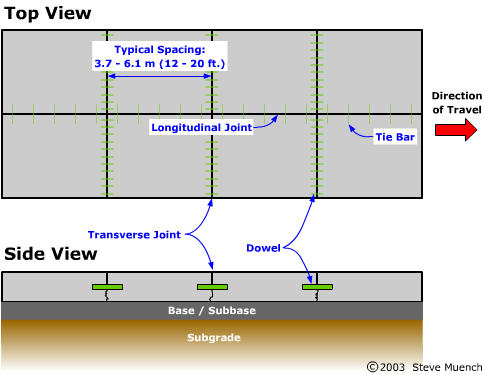
Jointed plain concrete pavement (JPCP, Figure 1) uses contraction joints to control cracking and does not use any reinforcing steel. Transverse joint spacing is selected such that temperature and moisture stresses do not produce intermediate cracking between joints. This typically results in a spacing no longer than about 6.1 m (20 ft.). Dowel bars are typically used at transverse joints to assist in load transfer. Tie bars are typically used at longitudinal joints.
Properties
Crack Control
Contraction joints, both transverse and longitudinal
Joint Spacing
Typically between 3.7 m (12 ft.) and 6.1 m (20 ft.). Due to the nature of concrete, slabs longer than about 6.1 m (20 ft.) will usually crack in the middle. Depending upon environment and materials slabs shorter than this may also crack in the middle.
Reinforcing Steel
None.
Load Transfer
Aggregate interlock and dowel bars. For low-volume roads aggregate interlock is often adequate. However, high-volume roads generally require dowel bars in each transverse joint to prevent excessive faulting.
Other Info
A majority of U.S. State DOTs build JPCP because of its simplicity and proven performance.
Teaching this? Figures and worked examples are free to use with credit. Course reading lists
Cite this page
APA
Pavement Interactive. (2026, November 1). Jointed plain concrete pavement. HeadLight. Retrieved [the date you read it], from https://pavementinteractive.org/reference-desk/pavement-types-and-history/pavement-types/jointed-plain-concrete-pavement/
ASCE
Pavement Interactive. (2026). “Jointed Plain Concrete Pavement.” HeadLight, <https://pavementinteractive.org/reference-desk/pavement-types-and-history/pavement-types/jointed-plain-concrete-pavement/> ([the date you read it]).
BibTeX
@misc{pavint-jointed-plain-concrete-pavement,
  author = {{Pavement Interactive}},
  title = {Jointed Plain Concrete Pavement},
  year = {2026},
  publisher = {HeadLight},
  howpublished = {\url{https://pavementinteractive.org/reference-desk/pavement-types-and-history/pavement-types/jointed-plain-concrete-pavement/}},
  note = {Accessed [date]}
}