Sieve
Reviewed by licensed engineers
Checked against its sources by licensed professional engineers on the previous site, where reviewers weren’t recorded by name.
A sieve is a mechanical device used to separate samples of different sizes.
Sieve sizes typically used for Superpave mix design are 1½ in, 1.0 in, ¾ in, ½ in, 3/8 in, No. 4, No. 8, No. 16, No. 30, No. 50, No. 100 and No. 200 (37.5, 25.0, 19.0, 12.5, 9.5, 4.75, 2.36, 1.18, 0.600, 0.300, 0.150 and 0.075 mm) sieves. Assemble the sieves in order of decreasing size of opening from top to bottom and place the nest of sieves over a pan (Video 1).
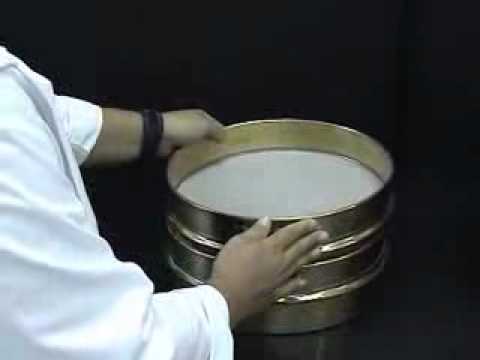
The sample is poured into the top sieve in the nest (Figure 1).

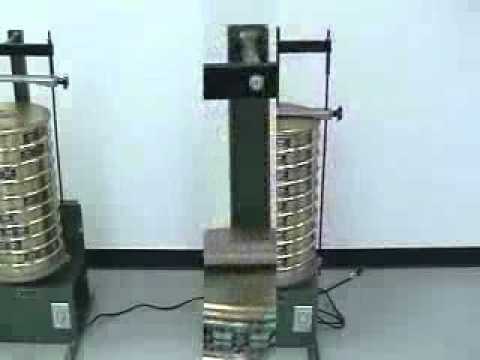
After the sample is loaded, the material is sieved in a mechanical sieve shaker (Figure 2 and Video 2).

Teaching this? Figures and worked examples are free to use with credit. Course reading lists
Cite this page
APA
Pavement Interactive. (2019, September 6). Sieve. HeadLight. Retrieved [the date you read it], from https://pavementinteractive.org/reference-desk/testing/aggregate-tests/sieve/
ASCE
Pavement Interactive. (2019). “Sieve.” HeadLight, <https://pavementinteractive.org/reference-desk/testing/aggregate-tests/sieve/> ([the date you read it]).
BibTeX
@misc{pavint-sieve,
  author = {{Pavement Interactive}},
  title = {Sieve},
  year = {2019},
  publisher = {HeadLight},
  howpublished = {\url{https://pavementinteractive.org/reference-desk/testing/aggregate-tests/sieve/}},
  note = {Accessed [date]}
}