Building Smooth Pavements
Building a smooth pavement means controlling grade, paver operation and material supply so that the finished surface has as few bumps, dips and waves as possible. Smoothness depends on every layer, from the subgrade to the surface course, and on steady, uninterrupted paving.
Why Smoothness Matters
Smoothness is usually the first quality the traveling public notices. It also improves fuel economy for road users and lengthens pavement life, and many agencies use it to judge completed projects, with bonuses or penalties tied to measured smoothness. How smoothness (or its opposite, roughness) is measured and expressed is covered in Roughness.
A smooth surface is the product of a well-built foundation, a carefully designed pavement structure, good paving practice and clear communication between the paving crew, the trucks and the plant.
Grade and Elevation Control
Profile and elevation, including grade and cross slope, have to be built correctly into the subgrade and base before the surface can be smooth. Elevation errors left in lower layers are hard to remove by varying the thickness of the asphalt above them, because thicker areas of a lift compact more than thinner areas (see Subgrade Preparation for New Pavements and Existing Surface Preparation for Overlays).
On both new construction and overlays, horizontal and vertical control is usually set by a survey crew with stakes and string lines. The subgrade, base and any leveling course are checked against these references, so they must be set accurately. Good practice includes:
- checking string lines through the day, since they move as temperature and humidity change; and
- shortening the distance between line anchors where the grade changes sharply, so the line follows the design grade more closely.
Continuous Paving
Every time the paver stops, the uniformity of the mat can be disturbed at the stopping point. Planning to minimize starts and stops is therefore one of the main ways to build a smooth surface.
The most common cause of unplanned stops is running out of mix. Common practices to keep material arriving at a steady rate are:
- giving the plant at least 24 hours' notice of the planned start and stop times, the quantity of mix needed and the type of trucks being used; and
- keeping truck drivers and the paver operator in continuous contact about traffic and delays during paving.
Matching truck supply to paver speed is discussed further in End Dump Truck and Material Transfer Vehicles.
Paver Operation
Automatic Grade and Slope Control
An existing surface is rarely level enough for the free-floating screed to produce a smooth mat by itself, and it is very difficult even for experienced operators to hold grade and slope manually over a variable surface. Automatic grade and slope controls keep the screed tow points at a constant elevation relative to an external reference rather than to the paver's own wheelbase. The reference is usually a string line or a mobile reference on the paver: either a contact device such as a ski, or a non-contact ultrasonic sensor. Because the controls hold the tow points steady, the tractor can ride up and down over the existing roughness without that roughness being copied into the mat. A mechanical averaging ski, for example, sets the tow point elevation from the average height of the existing surface along its length, which reduces the effect of small dips and crowns. How the screed and its controls work is covered in Asphalt Paver.
Minimal Manual Screed Adjustment
Mat thickness should be checked at the start of each run to confirm the screed is at the right height. If it is not, the screed may need adjusting, but several measurements should be taken before any change is made. A screed that is adjusted constantly never settles, and the mat will be rougher as a result.
As a rule of thumb, the screed takes about five tow-arm lengths of travel to complete a change in setting, with most of the change happening in the first one or two lengths. Thickness should be rechecked after that distance.
Truck Exchanges
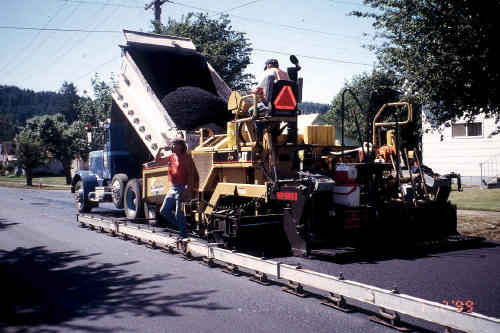
A careful truck exchange avoids bumps. The truck should back up and stop just short of the paver, and the paver should move forward to pick it up. A truck that backs into the paver can push the screed down and leave a bump in the mat that will not roll out. Once the paver has picked up the truck, the driver releases the brake and lets the paver push the truck, applying light braking if needed (especially on a downgrade) to keep the truck from rolling away from the paver.
Transverse Joints
Transverse joints are a frequent source of bumps, and careful joint construction is part of building a smooth pavement. See Joints and Other Joints.
Measuring Smoothness
Smoothness is most commonly expressed with the International Roughness Index (IRI). Agencies use IRI to evaluate new pavements and overlays, to set pay adjustments (bonuses and penalties), and to locate areas that must be corrected.
Two kinds of device are widely used on construction projects:
- Profilographs are rolling beams with a sensing wheel mounted at the center of the frame, free to move vertically. The wheel's movement relative to the reference plane of the frame is recorded, automatically on some models. Profilographs can detect slight deviations up to about 20 feet (6 m) long. Contractors often use them for quality control, to find bumps that need correcting before the agency measures the pavement.
- Inertial profilers are mounted in vans that carry acoustic or optical sensors and the computers needed to process their data. They are used at highway speed to collect roughness data over networks, and many agencies use them for acceptance testing. The same vehicles can also collect texture, condition and distress data.
Summary
Smooth pavements come from accurate grade control in every layer, steady paving without unplanned stops, automatic screed controls with few manual adjustments, careful truck exchanges and joints, and measurement that finds rough areas while they can still be corrected.
Teaching this? Figures and worked examples are free to use with credit. Course reading lists
Cite this page
APA
Pavement Interactive. (2026, November 1). Building smooth pavements. HeadLight. Retrieved [the date you read it], from https://pavementinteractive.org/reference-desk/construction/placement/building-smooth-pavements/
ASCE
Pavement Interactive. (2026). “Building Smooth Pavements.” HeadLight, <https://pavementinteractive.org/reference-desk/construction/placement/building-smooth-pavements/> ([the date you read it]).
BibTeX
@misc{pavint-building-smooth-pavements,
  author = {{Pavement Interactive}},
  title = {Building Smooth Pavements},
  year = {2026},
  publisher = {HeadLight},
  howpublished = {\url{https://pavementinteractive.org/reference-desk/construction/placement/building-smooth-pavements/}},
  note = {Accessed [date]}
}